
Lab support
The network runs three subjects. Each has its own protocol: what you receive, how the assay runs, how compounds are handled, and how results are shared. Choose the one your lab is working on.
Getting started
What you will receive to begin assays
- Standardized 3D printed platform to conduct assay
- Hemotek 1 mL blood reservoir (product code: R29P10)
- Hemotek blood-feeding membrane (product code: MEM5)
- Peltier heating base
- Test compounds and DEET (positive control) shipments, including safety data sheets. Please run DEET as a positive control to confirm that the assay is detecting repellent behavior.
- Standard template for recording data and access to shared repositories to upload your lab’s assay data
- Assay protocols, video training and support, and help with data formatting and analysis.
What you will need to provide
- Reliable access to a standardized wild-type Liverpool strain Aedes aegypti colony (if you are in the U.S., we can provide this to you). If your lab has access to another colony and would prefer to use that for assay data, please reach out to us to move forward.
- Temperature- and humidity-controlled behavioral testing room maintained at 28 ± 2°C and 50–70% relative humidity (RH).
- Please ensure that the behavior chamber has air purifiers or is connected to a fume hood/exhaust system.
- Insect holding/rearing cages
- Sheep or bovine blood. You will need approximately 1 mL per assay run: 6 mL per compound for the treated runs, plus 6 mL per assay day for the six shared controls.
- Mosquito netting or mesh (if applicable)
- Micropipettes (P20, P200, and P1000) and sterile pipette tips
- Glass vials or microcentrifuge tubes for solution preparation
- Timer
- Aspirator for insect transfer
- Thermometer and hygrometer
- Cell phone or webcam with HD video (1080p) recording capability
- Camera mount
- Cages (BugDorm-4E1515 Small Insect Rearing Cage)
- Control solvent (1% ethanol in water)
Assay
Preparing the insect cages
- Use a modified BugDorm® Small Insect Rearing Cage as the assay cage. One mesh side of the cage shall be removed and replaced with a transparent acrylic panel to facilitate video recording and accurate observation of mosquito landings during the assay.
- Ensure that each cage is clean, dry, and free of residual odors or chemical contamination before use. Inspect the acrylic panel and mesh for damage and confirm that the cage is securely sealed.
- Label each cage with the assay identification number, treatment group, replicate number, date, and operator initials.
- Using an aspirator, transfer 20 healthy, host-seeking mated female mosquitoes of 1–3 weeks age into each cage. Minimize handling to reduce stress and avoid injury to the insects.
- Allow mosquitoes to acclimate to the assay room under standardized environmental conditions for 30–60 minutes before initiating the assay.
Preparing the mosquito landing surface
- Inspect the provided 3D-printed platform for structural integrity and a smooth, defect-free finish before use.
- Clean the landing platform before each assay and allow it to dry completely.
- The 3D-printed platform is heat resistant up to 80°C, allowing it to be heated between assays to remove residual volatile compounds and minimize cross-contamination without damaging the arena.
Arena layout (top-down view of the platform)

Assay configurations

Side cross-section of the same 3D-printed platform in the two assay configurations: (A) contact form and (B) non-contact form.
Control assay procedures
- Fill a Hemotek blood-feeding reservoir with sheep or bovine blood and securely mount the membrane according to the manufacturer's instructions.
- Place the Hemotek reservoir on a heating pad or Hemotek heating unit and preheat the blood to 34–37°C before initiating the assay.
- Position the blood feeder beneath the pre-cut opening in the foam board so that the membrane containing the warmed blood is the only accessible heat source for the mosquitoes.
- Place the mosquito cage containing 20 mated, host-seeking female mosquitoes and the 3D-printed platform on top of the blood feeder, ensuring that the blood feeder is aligned directly beneath the central mesh opening of the landing arena. This arrangement allows mosquitoes to detect host-associated cues while preventing direct access to the blood meal.
- Run three contact and three non-contact controls each day and use these controls for all chemicals tested that day.
- For the non-contact control, apply 50 µL of 1% ethanol in water to the inner surface beneath the landing zone.
- For the contact control, apply 50 µL of 1% ethanol in water directly to the landing surface.
- Allow the solvent to evaporate completely before starting each control assay.
- Once the cage is properly positioned, begin the assay immediately.
- Record mosquito behavior for 5 minutes using a top-mounted camera through the transparent acrylic panel of the modified BugDorm cage.
Contact and non-contact assay procedure
Non-contact assay
- Prepare the test chemical at 1% concentration using 1% ethanol in water as the solvent.
- Apply 50 µL of the diluted test chemical to the inner surface beneath the landing zone, ensuring that the treated surface is not accessible to the mosquitoes.
- Allow the solvent to evaporate completely before starting the assay.
- During the assay, mosquitoes are exposed only to the volatile (airborne) components of the test chemical and are unable to make physical contact with the treated surface.
- Position the mosquito cage on the blood feeder and begin the assay.
- Record mosquito behavior for 5 minutes using a top-mounted camera through the transparent acrylic panel of the modified BugDorm cage.
Contact assay
- Prepare the test chemical at 1% concentration using 1% ethanol in water as the solvent.
- Apply 50 µL of the diluted test chemical directly onto the 3D-printed platform within the designated landing zone.
- Allow the solvent to evaporate completely before starting the assay.
- During the assay, mosquitoes are able to land on and physically contact the treated surface, allowing them to detect both the volatile and non-volatile components of the test chemical.
- Position the mosquito cage on the blood feeder and begin the assay.
- Record mosquito behavior for 5 minutes using a top-mounted camera through the transparent acrylic panel of the modified BugDorm cage.
Watch assays
Compounds
Monthly shipments
You will receive 10 compounds (not including DEET) to begin your assay work after your application and delivery details are approved. After data from the first 10 compounds has been recorded and checked by the Monarch team, each lab will receive 20 compounds each month. Each set of compounds will include unique candidates our models rank as most likely to stop a mosquito from landing, including a shared panel of compounds sent to multiple labs to establish inter-lab variance.
Your lab is the importer of record for chemical shipments. Tell us in advance if it caps quantities or restricts any hazard class.
Handling & storage
- Store compounds as labeled on arrival; keep them in the dark and at the labeled temperature.
- Let vials equilibrate to room temperature before opening to avoid condensation.
- Prepare working dilutions fresh on the day of the assay. The standard screen uses 1% ethanol as solvent unless the protocol sheet says otherwise.
Safety
Every compound will be shipped with a safety data sheet including GHS classification. The shipment will be classified and packed to IATA/DOT standards. Monarch will disclose structure to an EHS officer on request.
Handle all compounds with standard chemical-lab hygiene: gloves, lab coat, eye protection, and fume-hood preparation of dilutions.
Compound delivery details are submitted as part of the Request Access application.
Insectary
Testing each compound requires six treated runs: three non-contact and three contact, with 20 age-matched adult female mosquitoes per assay, for a total of 120 females per compound. Each assay day requires six additional shared control runs, three non-contact and three contact, using 120 females. Use these daily controls for all chemicals tested that day.
The insectary should maintain enough healthy, age-matched mated adult female mosquitoes for the treated runs, the shared daily controls, routine colony maintenance, and failed runs. Plan for at least 240 adult females per compound before accounting for mortality, failed runs, or colony maintenance.
Data
Sharing your data
- Your workspace is created when you register on the Lab Portal. The portal shows its Lab ID and the cloud storage structure
<Lab ID>/Metadata/and<Lab ID>/Video Footage/. - Complete the metadata worksheet with your assay results. Download the mosquito template here, or select the mosquito template in the portal to download a copy prefilled with your Lab ID in the first
lab_idcolumn. Name it[lab_id]_metadata_[date].xlsx; for examplemzero4821_metadata_2026-08-13.xlsx. Submit one worksheet per compound, including its six treated runs and six matching daily controls. - Choose the completed manifest in the Metadata slot. CSV, TSV, XLSX, and JSON files are read in your browser before transfer so the portal can check required values, the Lab ID, compound and batch IDs on treated runs, the shared daily controls, duplicate filenames, and required columns. Correct and re-select a file as often as needed. Unusual but valid values, such as 31°C, are warnings and do not block submission. Submit remains unavailable until the manifest has no blocking errors and all twelve matching videos are selected.
- Select all twelve MP4, MOV, or WebM assay recordings together: six treated runs for the compound, plus three shared daily contact and three shared daily non-contact controls. Use
[lab_id]_[date]_[treatment]_[condition]_[replicate]; for examplemzero4821_2026-08-13_DEET_contact_01.mov. Camera defaults likeIMG_0028.movare not accepted. Every selected filename must appear exactly once in thefile_namecolumn of your metadata; mismatches are blocked before transfer. - Upload all videos within 24 hours of completing the run or of a minimal quality review where one is needed. Submit positive, negative, and inconclusive results alike.
- Keep your source video files for 12 months so runs can be re-scored if the analysis pipeline is updated.
Accepted metadata formats in the portal: CSV, TSV, XLSX, and JSON. Accepted video formats in the portal: MP4, MOV, and WebM. Each successful transfer receives a traceable receipt with its folder, object name, generation, checksum, and validation status.
Data Quality
All labs run a fixed protocol on the same assay, use three contact and three non-contact solvent controls for every chemical tested that day, and test a shared compound panel at the same concentrations.
We will report the following metrics to assess data reliability:
- Inter-assay correlation (r)
- Hit re-test rate
- Inter-lab variance (CV)
- z-score
Data analysis and compound ranking
Compounds will be ranked by a cumulative landing-zone occupancy metric. Each frame of the assay video footage shows the number of mosquitoes in the landing zone (inside plus red ring) multiplied by the frame interval. Summed across the assay, this gives cumulative mosquito-time in the zone, measured in mosquito-seconds: six mosquitoes present for one second is six mosquito-seconds. Each compound is scored as the percent reduction in occupancy against the matching daily contact or non-contact controls.
Total mosquito-seconds = sum((n_inside + n_on_band) × dt).
The video footage also supports finer-grained behavioral measures, including spatial distribution, distance from the treated surface, entry and exit rates, dwell time, and how these change over the assay.
Accessing data
Metadata files and video footage from every participating lab are readable by all labs; you have edit access to your own lab's folder only.
Use the Lab Portal's recent uploads section: select this lab for the current workspace, all labs for research uploads shared across the registered network, and refresh after a new submission. The portal is the normal access path. A cloud storage console link works only for a Google account that has separately been granted direct bucket access.
Metadata worksheets and video footage stay within the network and are not redistributed publicly.
This is a cloud storage workspace managed through the Monarch portal, not a Google Drive folder.
Commons
Repellent compound identities will be published under CC BY 4.0. Metadata files and video footage are shared across all participating labs.
Getting started
What you will receive to begin assays:
- Standardized 3D printed DART tray to conduct assay
- Glass tubes for fly DART assay
- Standardized 3D printed endcaps with snap-on grate
- Raspberry puree (fly attractant)
- Test compounds (including 1-octen-3-ol as a positive control), including safety data sheets. Please run the positive control to confirm that the assay is successfully detecting repellent behavior.
- Control solvent (dipropylene glycol / DPG)
- Standard template for recording data and access to shared repositories to upload your lab’s assay data
- Assay protocols, video training and support, and help with data formatting and analysis.
What you will need to provide:
- Reliable access to a wild-type SWD/Drosophila suzukii colony. If your lab has access to a specific strain and would prefer to use that for assay data, please reach out to us to move forward.
- Temperature- and humidity-controlled behavioral testing room maintained at 24 ± 2°C and 50–70% relative humidity (RH).
- Please ensure that the behavior chamber has air purifiers or access to a fume hood/exhaust system.
- Insect holding/rearing cages
- Micropipettes (P20, P200, and P1000) and pipette tips
- Glass vials or microcentrifuge tubes for solution preparation
- Timer
- Aspirator for insect transfer
- Thermometer and hygrometer
- Webcam or cell phone camera with Full HD capability (1080p).
Assay
Preparing the DART tubes:
One glass DART tube requires endcaps with snap-on grate at each end. Each cap should contain 45 uL of raspberry puree with 10 uL of experimental solution or control solvent spread thinly and evenly on the surface of the grate. For experimental replicates, one endcap should be treated with the test solution and the other with control, varying which end between trials (treatment locations are recorded in the metadata file).
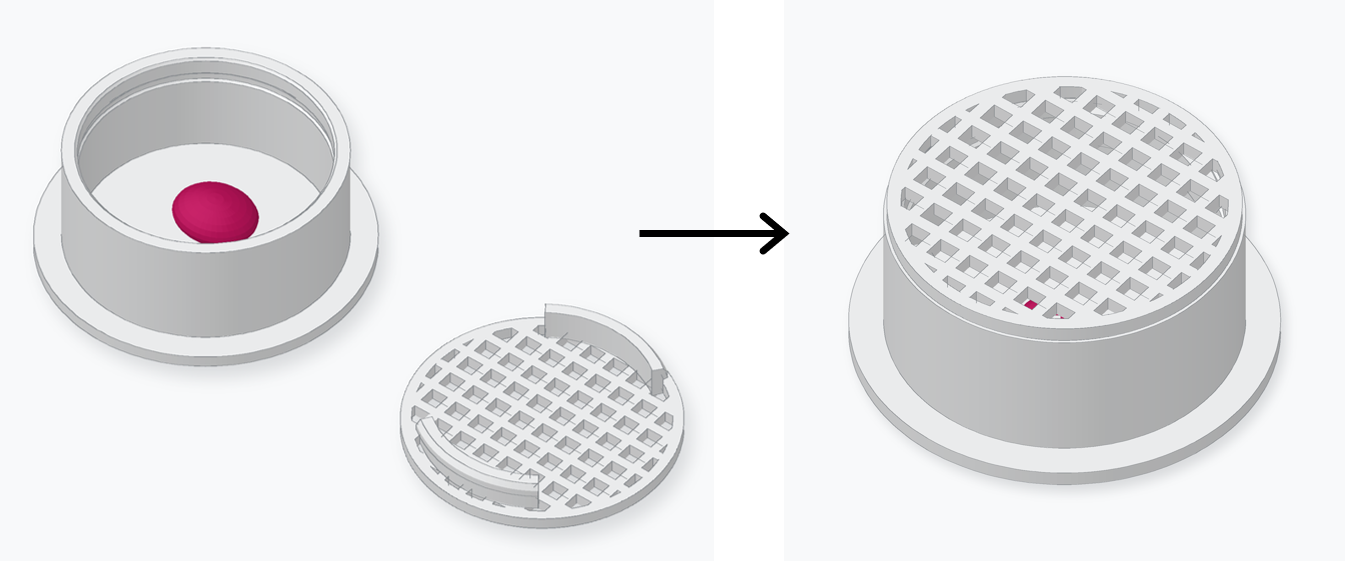
After application of the solution, the endcaps are inserted into the glass tube which is placed in the tube holder tray. This step should be completed efficiently to reduce dissipation of test compounds.
Adding experimental flies:
Using an aspirator, approximately 15 adult flies (6-8 days old) are inserted in each tube. The flies should be evenly distributed and not heavily biased to one side of the tube before starting the assay.
Filming:
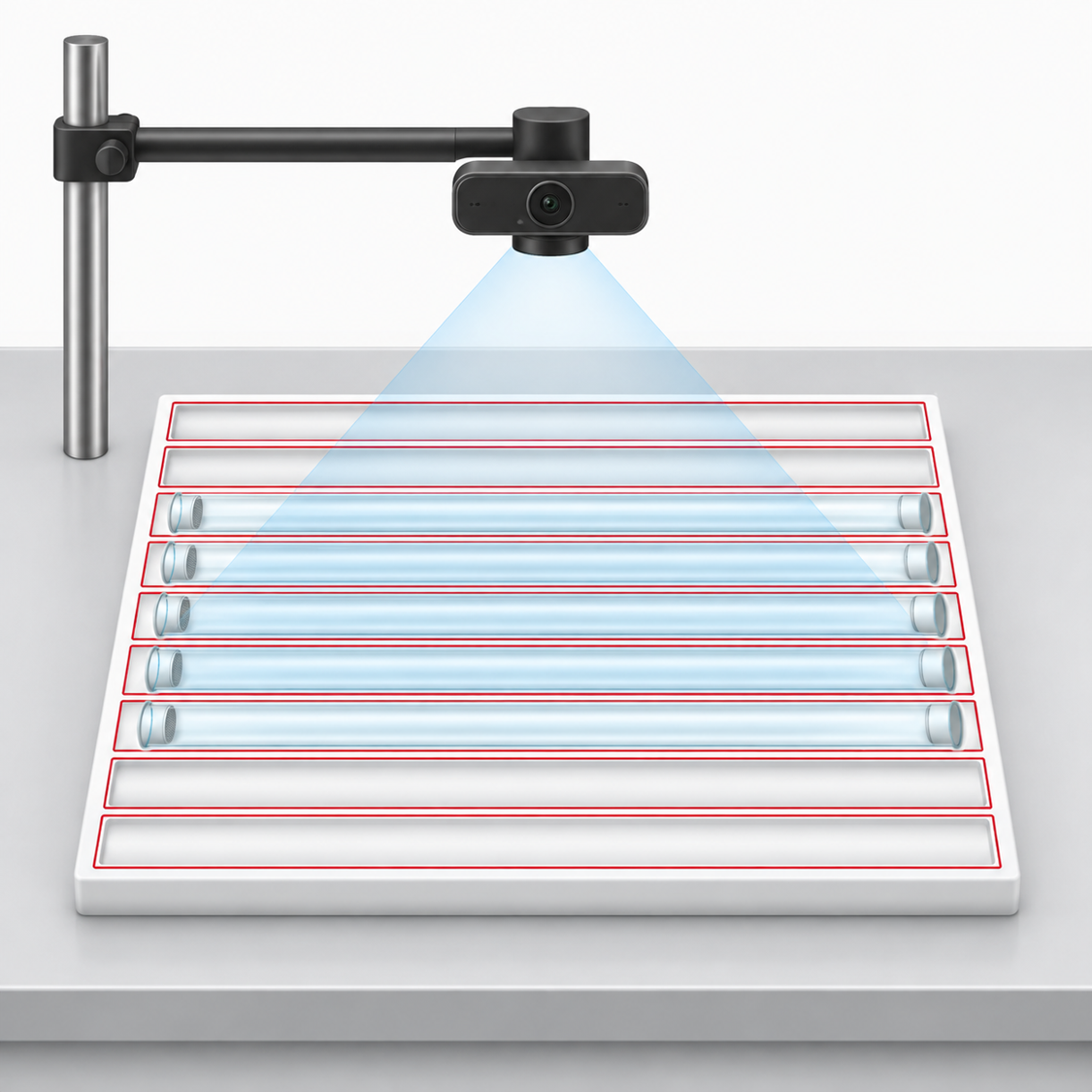
Filming should be done with a Full HD (1080p) compatible camera. To enhance detection of flies using computer vision models, lighting should be managed to reduce glare on the tubes as much as possible and the camera should be placed at a distance where 6 slots of the tube tray are fully visible in landscape orientation (including the red outline) and occupy the entire camera field. Placing the camera at a distance or zoom where more space is visible around the tubes/tray reduces model accuracy and is not recommended. Each assay should be filmed for 30 minutes to allow flies to respond to test compounds.
After filming:
Following completion of an assay the tubes should be dismantled, washed, and allowed to dry. The 3D printed endcaps are thermally stable up to 80°C and can be heated between assays to remove residual volatile compounds and minimize cross-contamination without damage. Glass tubes can also be heated to remove residual volatiles.
Control assay procedures:
Control assays are conducted using 10 uL dipropylene glycol (DPG) on each endcap grate without the addition of any test compound. A minimum of 2 controls should be run for each day experiments are conducted. Initially it may be necessary to run several rounds of controls to check for any bias in fly behavior due to handling, lighting, or other non-experimental factors.
Time Allocation and required replication
Each compound requires 12 replicates. With the camera setup capturing 6-tubes per video, this equals two videos per compound plus daily controls (at least 2 control tubes per day). For more rigorous testing, replicates for each compound should be spread across at least 2 days (e.g. 6 replicates on day 1 and 6 on day 2).
Each compound requires ~1.75 hours to run controls, replicates and post assay cleaning. This does not include the time needed to grow and maintain the insectary.
Compounds
Monthly shipments
You will receive 10 compounds (not including 1-octen-3-ol) to begin your assay work after your application and delivery details are approved. After data from the first 10 compounds has been recorded and checked by the Monarch team, each lab will receive 20 compounds each month. Each set of compounds will include unique candidates predicted by our models, including a shared panel of compounds sent to multiple labs to establish inter-lab variance.
Your lab is the importer of record for chemical shipments. Tell us in advance if it caps quantities or restricts any hazard class.
Handling & storage
- Store compounds as labeled on arrival; keep them in the dark and at the labeled temperature.
- Let vials equilibrate to room temperature before opening to avoid condensation.
- Prepare working dilutions fresh on the day of the assay. The standard screen uses dipropylene glycol as the solvent unless stated otherwise.
Safety
Every compound will be shipped with a safety data sheet including GHS classification. The shipment will be classified and packed to IATA/DOT standards.
Handle all compounds with standard chemical-lab hygiene: gloves, lab coat, eye protection, and fume-hood preparation of dilutions.
Compound delivery details are submitted as part of the Request Access application.
Insectary
Testing a single compound requires 12 replicates (tubes) plus appropriate controls. At an average of 15 flies per replicate this equals 180 flies per compound not including control trials. Each day assays are run requires control runs. Use these daily controls for all chemicals tested that day.
The insectary should maintain enough healthy, age-matched adults for the treated runs, the daily controls, routine colony maintenance, and failed runs. At an approximately 1:1 sex ratio, plan for at least 300 adults per compound plus at least 30 adults per assay day before accounting for mortality, failed runs, or colony maintenance.
Data
Sharing your data
Your workspace is created when you register on the Lab Portal. The portal shows its Lab ID and the cloud storage structure <Lab ID>/Metadata/ and <Lab ID>/Video Footage/.
Complete the fly metadata workbook with your assay results. Download the template here, or download it from the Lab Portal. Replace the sample rows in trials with your lab’s records and enter your Lab ID in the lab_id column. Keep the readme and chemical-key sheets for reference. Dates use mmddyyyy. Name the completed file [lab_id]_metadata_[date].xlsx, using the first assay date; for example mlabhq_metadata_08132026.xlsx. Submit one workbook per compound, including its treated runs and matching daily controls across all assay days.
Record one row per tube. Repeat the recording's filename for each tube it contains, and record the tube number in tube and its position in the holder in slot, numbered 1–6 from the top of the video to the bottom. Record each end's contents in left_condition and right_condition, and the treatment position as L or R in treatment_position.
Choose the completed manifest in the Metadata slot. CSV, TSV, XLSX, and JSON files are read in your browser before transfer so the portal can check required values, the Lab ID, treatment and dilution, the daily controls, tube and slot identifiers, and required columns. Correct and re-select a file as often as needed. Unusual but valid values, such as 31°C, are warnings and do not block submission. Submit remains unavailable until the manifest has no blocking errors and all matching videos are selected, including the two videos per compound and the daily control recordings.
Select all MP4, MOV, or WebM assay recordings together: two videos per compound, each capturing six tubes, plus the daily control recordings. Use [lab_id]_[date]_[treatment]; for example mlabhq_08132026_1O3OL.mov. Camera defaults like IMG_0028.mov are not accepted. Select each recording once, even though its filename appears on several tube rows in your metadata; mismatches are blocked before transfer.
Upload within 24 hours of completing the run or of a minimal quality review where one is needed. Submit positive, negative, and inconclusive results alike.
Keep your source video files for 12 months so runs can be re-scored if the analysis pipeline is updated.
Accepted metadata formats in the portal: CSV, TSV, XLSX, and JSON. Accepted video formats in the portal: MP4, MOV, and WebM. Each successful transfer receives a traceable receipt with its folder, object name, generation, checksum, and validation status.
Data Quality
All labs run a fixed protocol on the same assay, run daily controls, and test a shared compound panel at the same concentrations.
We will report the following metrics to assess data reliability:
- Inter-assay correlation (r)
- Hit re-test rate
- Inter-lab variance (CV)
- z-score
Data analysis and compound ranking
Repellency is analyzed using three different preference index calculations where preference is calculated using fly counts as follows:
PI = (Left − Right) / (Left + Right)
The 3 generated preference indices are calculated where the measured zone (Left/Right) corresponds to: 50% of the DART tube, 16.66% at either end of the tube (1/6th), or 8.33% at either end of the tube (1/12th). These metrics are calculated both over time, and as an average PI at the end of the experiment. These preference indices are then compared against their respective controls, and statistical significance is used to determine repellency.
The video footage also supports finer-grained behavioral measures, including spatial distribution, distance from the treated surface, entry and exit rates, dwell time, and how these change over the assay.
Accessing data
Metadata files and video footage from every participating lab are readable by all labs; you have edit access to your own lab's folder only.
Use the Lab Portal's recent uploads section: select this lab for the current workspace, all labs for research uploads shared across the registered network, and refresh after a new submission. The portal is the normal access path. A cloud storage console link works only for a Google account that has separately been granted direct bucket access.
Metadata worksheets and video footage stay within the network and are not redistributed publicly.
This is a cloud storage workspace managed through the Monarch portal, not a Google Drive folder.
Commons
Repellent compound identities will be published under CC BY 4.0. Metadata files and video footage are shared across all participating labs.
Field trials
Soft fruit · spotted wing drosophila
Spotted wing drosophila (Drosophila suzukii) lays eggs inside ripening fruit, so damage is done before growers can see it. The field trial asks one question: does a compound that stopped flies from landing in the lab also protect ripening fruit on a living plant?
Field trials advance compounds that showed promise in standardized lab assays onto living plants and real-world conditions. Field results are training data too: every trial, positive or negative, teaches our models how lab behavior translates to the crop.
Crop Species
Field methods are defined by crop type and relevant endpoint measurements. For soft fruits Monarch Labs is currently focused on damage by spotted-wing drosophila (Drosophila suzukii) in raspberry, strawberry, blackberry, cherry, and blueberry.
Participating laboratories will need to provide:
- Reliable access to experimental field plots with natural spotted-wing infestation, or access to experimental field plots suitable for field-release of spotted-wing drosophila and access to a wild-type colony.
- A temperature and humidity data logger at the trial site
- Micropipettes (P200 and P1000) and sterile pipette tips
- Glass vials or microcentrifuge tubes for solution preparation
- Timer, aspirator for insect transfer
- Ventilated containers for holding harvested fruit for SWD emergence.
Participating laboratories will receive:
- A standardized field protocol developed collaboratively with advisors at academic and government research institutes.
- Test compounds, including safety data sheets
- The field datasheet template for recording trial data, and access to shared repositories to upload it
- As-needed video training and support, and help with data formatting and analysis
Sharing your field data
Upload completed field worksheets and any landing recordings through the Lab Portal to the same workspace as your lab assay data, within 24 hours of scoring. Name files with your Lab ID and the trial date, following the same pattern as your assay uploads.
Field worksheets and recordings are shared across all participating labs under the same terms as assay data: readable by every lab in the network, with edit access to your own lab's folder only.
Brassica · diamondback moth
Diamondback moths (Plutella xylostella) lay eggs on brassica leaves, and developing larvae do the feeding damage. The field trial measures whether a candidate compound changes where females oviposit and ultimately reduces crop damage.
Field trials
Field trials advance compounds that showed promise in standardized lab assays onto living plants and real-world conditions. Field results are training data too: every trial, positive or negative, teaches our models how lab behavior translates to the crop.
Crop Species
Field methods are defined by crop type and relevant endpoint measurements. For Brassica, Monarch Labs is currently focused on damage by diamondback moth (Plutella xylostella) in all agriculturally relevant brassica varieties.
Participating laboratories will need to provide:
- Reliable access to experimental field plots with natural diamondback moth infestation, or access to experimental field plots suitable for cage trials and access to a wild-type colony.
- A temperature and humidity data logger at the trial site
- Micropipettes (P200 and P1000) and sterile pipette tips
- Glass vials or microcentrifuge tubes for solution preparation
- Timer, aspirator for insect transfer
Participating laboratories will receive:
- A standardized field protocol developed collaboratively with advisors at academic and government research institutes.
- Test compounds, including safety data sheets
- The field datasheet template for recording trial data, and access to shared repositories to upload it
- As-needed video training and support, and help with data formatting and analysis
Sharing your field data
Upload completed field worksheets and any landing recordings through the Lab Portal to the same workspace as your lab assay data, within 24 hours of scoring. Name files with your Lab ID and the trial date, following the same pattern as your assay uploads.
Field worksheets and recordings are shared across all participating labs under the same terms as assay data: readable by every lab in the network, with edit access to your own lab's folder only.